Safe Online: The Startup Helmit Is Committed to Digital Child Protection
Cyberbullying, social media addiction, paedocrime - when you think of the many dangers that children and young people are exposed to online, the hairs on the back of your neck stand on end. The Munich-based start-up Helmit has set itself the task of translating child protection into the digital world and has developed software to help parents do just that.
Alexander, Leonardo, why did you see the need to found Helmit ?
Leonardo: Alex and I have actually known each other since kindergarten. We were at university – I was studying math, Alex electrical engineering – when we both developed the ambition to get something off the ground together. We thought about where the important problem areas were and which topic was worth investing seven to ten years of our lives in. We quickly came up with social media safety and online safety for children in general. We are familiar with digital violence from our childhood and youth. We are part of Gen Z and have seen the negative consequences that social media can have with many of our friends. I have also experienced online bullying myself. A look at the statistics reveals that digital violence is increasing every year. At the same time, the platforms themselves are not taking responsibility for this. If they don’t take care of it, then we will.
From cyberbullying to fraud: The dangers online for children are manifold
Children today no longer know a world without smartphones and the internet. What are the biggest dangers for them?
Alexander: That’s a huge range. This includes cyberbullying, where children are bullied by their classmates in class chats. Then there’s cybergrooming, where children are contacted by pedo-criminals with sexual intentions. This is particularly dangerous because children are usually completely unable to assess the situation. In addition, inappropriate content is posted on social media – horror videos, self-harm, sexual content. This is sometimes difficult for adults to cope with and of course even worse for children. A major problem in all of this is the sense of shame that often resonates with children and ensures that they keep such situations to themselves instead of confiding in their parents.
Leonardo : Another danger that many people are unaware of is sextortion. This is similar to cybergrooming, but adults write to children and young people with financial rather than sexual ulterior motives. They pretend to be their peers, start a chat and get the young people to send intimate pictures. They then use them to blackmail them.
Why are parents often helpless when it comes to protecting their children?
Alexander: Parents are always in a dilemma here. On the one hand, they want to protect their children, even in the digital world. On the other hand, they don’t want to invade their children’s privacy too much. And: they actually have little insight because they cannot see what is happening on their children’s smartphones. At the same time, many parents find it difficult to understand the various platforms because they have not grown up with them. They don’t know what exactly happens there, how and with whom children come into contact.

The aim of social platforms is not to protect children and offer parents solutions. Rather, they want to hack children’s attention so that they stay on the platforms for as long as possible. They are designed to be addictive. The more people are on a platform, the more advertising space it can sell.
Alexander Wolters
Why don’t the platforms themselves do anything about digital violence against children and young people?
Alexander: Because there is a clear conflict of interest here. Their aim is not to protect children and offer parents solutions. Rather, they want to hack children’s attention so that they stay on the platforms for as long as possible. They are designed to be addictive. The more people are on a platform, the more advertising space it can sell. This is also the reason why platforms make it particularly easy to circumvent age restrictions. Social media such as WhatsApp or Instagram are actually for ages 13 and up, but are used much earlier.
What exactly does Helmit do here?
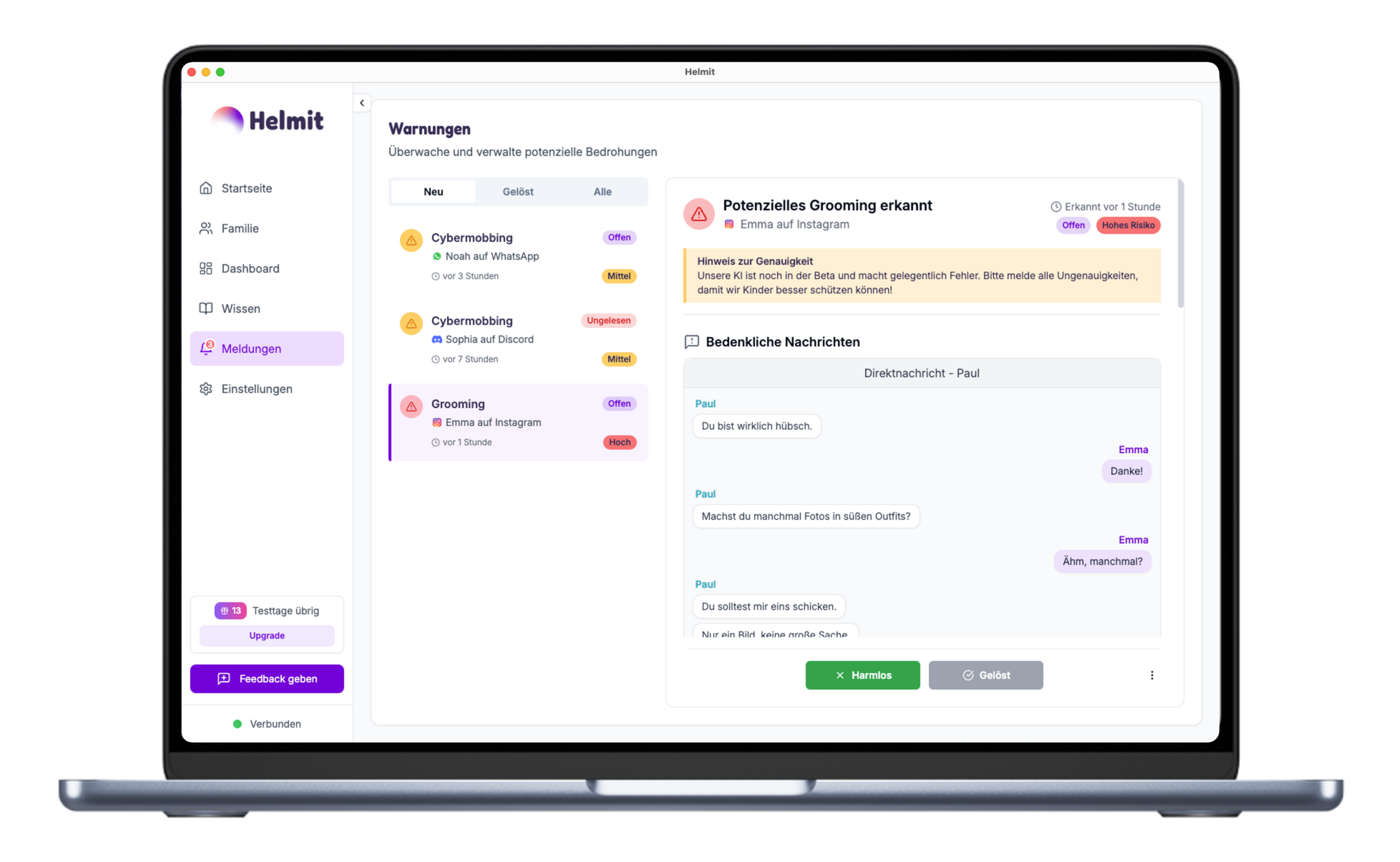
Alexander: We have developed a software that is linked to the children’s social media accounts and analyzes chats and interactions like an anti-virus software. Parents, in turn, are only informed on their own devices if a dangerous situation arises and are then sent a screenshot with the corresponding chat excerpt. They cannot read any more, so the children’s privacy remains protected. They can try out social media and move freely online, but there is still a protective mechanism that kicks in in an emergency.
Leonardo: We like to compare it to riding a bike: Here too, parents give their children a helmet when they are learning to ride. They should learn to find their way in traffic, but are still not on the road without protection. With us, the children get a digital helmet.
The AI recognizes all important dangers and sounds the alarm on parents’ devices
How exactly does the AI behind it work – and what happens when it actually sends a warning to parents’ devices?
Leonardo: We have trained the AI that analyzes the chats ourselves and it recognizes all important dangers. Parents can set how sensitively the warning system reacts. This depends, for example, on the age of the child or whether certain content is okay for parents, such as shooting games. In future, we want to offer even more customization options. We offer our software as a subscription model on a monthly or annual basis.
Alexander: If a warning message pops up, we provide parents with information on which organizations or contact points can help them in difficult cases or which conversation guidelines can help them talk to their child. Because we don’t just want to be a warning system, we also want to support parents in the next step. Throughout the entire process, all data is processed locally – nothing ends up in clouds or with third-party providers.


You have been on the market since the beginning of the year. How has your product been received?
Leonardo: We’re pretty happy with the feedback we’ve received so far. The communication between parents and children seems to be working. It was difficult for us to test this in advance: how the children react, whether they get involved or are more reluctant to do so. And: We have already been able to identify 1,000 dangers with Helmit, where parents have also confirmed that they found the message important. This is a huge motivation for us.
Many parents have suggested that they would like a Helmit app. Our software is currently available for laptops and PCs – for data protection reasons. The analyses are carried out locally on the devices and PCs have greater computing power. However, we have taken the feedback to heart and are currently working on an app that will be released in just a few weeks.
Alexander: We also want to offer new features in the app, such as screen time regulation. Helmit is designed to help parents manage everyday digital family life and become a media educator for your pocket with lots of tips that we develop together with experts.

It must become much more difficult to spread hate on the internet. And addictive designs must also be removed from social platforms. This should be prohibited by law and social media platforms should be severely prosecuted if they do not comply.
Leonardo Benini
With Helmit, you have just specialized in social media accounts. Do you want to cover other areas of the web in the future?
Alexander: Absolutely. We currently support WhatsApp, Discord, YouTube, Signal and Instagram. TikTok will be added soon. What we definitely want to tackle is the gaming industry. There are also many platforms like Roblox where you can get in touch with people and where many children and young people hang out. Roblox, for example, is a hotspot for paedophile crime – because it is much more anonymous there than on WhatsApp, for example.
The vision: No more digital violence on social media
If you could build an Internet entirely according to your wishes: What would it look like?
Alexander: We are guided by the vision that there is no more digital violence on social media or in the digital space in general. That you can use the advantages of the internet, exchange ideas with your friends, be entertained or acquire knowledge while staying safe. Two million children in Germany alone will be victims of cyberbullying in the course of their lives. That’s one in five children. We want to change that.
Leonardo: It must become much more difficult to spread hate on the internet. And addictive designs must also be removed from social platforms. This should be banned by law and social media platforms should be severely prosecuted if they don’t comply. I would like to see social media return to its original idea. So that it is once again a place where people can network, exchange ideas and connect. Because the internet is also full of good things that you can learn from.
Bannerbild: Helmite