Blautopf VR: From the Cave to the Winner’s Podium
And the winner is… Blautopf VR! The Munich-based company TELLUX next created an interactive Virtual Reality (VR) Adventure for the broadcasting company Südwestrundfunk (SWR) in which everyone can become a speleologist. On December 11, 2019, it won the Cologne Innovation Award. In the interview Philipp Schall, producer of Blautopf VR, talks about VR project importance and financing in the media industry.
TELLUX next has produced Blautopf VR for the SWR. How did this cooperation come about?
Philipp Schall: The subject “Fascinating world of caves” was already definite. It was very interesting to know that the entire speleologist scene from south-west Germany, Bavaria, and Austria is dominated by Swabians. SWR’s VR department is open to ideas from producers. As a co-producer, it supported us from the very beginning.
How does a public broadcasting company react to VR-projects? After all, VR is not necessarily part of the core business.
Schall: In general, the editorial staff and the general departments show a lot of interest. Of course, the broadcasters must fulfill their mission, but they also have to constantly rethink and develop it further. We worked in a very broadcaster-friendly way, when it came to financing and developing our idea. Next to the VR-product itself, we also created Web Scrollers and videos in order to get access to a large audience without VR.
Are you caught in the middle, when you produce a VR-format that is neither a classical film nor a game?
Schall: SWR‘s employees already tested a VR-headset, so I was quite happy I didn’t have to explain all the basics again. But from a technological point of view, our project is something new, for it is not based on computer animation but rather on photogrammetry (Editor‘s note: Photogrammetry is a metrological evaluation of photographs to generate 2D or 3D models). The interactivity aspect of Blautopf VR makes it much more similar to a game than a 360-degree film.
How does the distribution of VR work?
Schall: In the case of Blautopf VR, the project is distributed by SWR in German-speaking countries. We are currently searching for an international publisher. We would also like to exhibit the application in Blaubeuren’s museum, just over the Blautopf, though it is difficult to ensure the right working basis in such conditions. This includes technical equipment on one hand, and on the other, someone who can maintain the glasses and instruct the museum visitors.
How big is the share of subsidies in your production?
Schall: We made use of the Slate Funding provided by FilmFernsehFonds Bayern (FFF), which no longer exists in this form. This is how we could finance the production of different prototypes. A 360-degree-video was not an option because it takes quite some time to get into the caves and the lighting situation is not very suitable, which is why we started to work with photogrammetry.
The budget of the actual production has an entirely different dimension, so the FFF’s funding share (€50,000) of the total production was therefore relatively small. However, pre-production support is as important as other financing aspects, because the prototype makes the project possible in the first place. When you go from linear filmmaking to immersive and interactive forms, checking and learning a lot of new things is vital.
What kind of support do VR-makers need?
Schall: In order to implement VR in a way that complies with European standards, it would be helpful if the funding allowed a bigger budget.
Forums and business markets are also important to present new products. Events where you can meet individuals who aren’t already deeply involved in VR business are especially interesting, because people from the TV industry or the art and cultural scene can therefore get a chance to connect with VR-content.
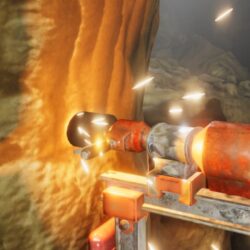
Screenshots from the VR-Adventure “Blautopf VR” (Photo: Philipp Schall, TELLUX Next GmbH)
Weiterführende Links:
https://www.swr.de/blautopf-vr/
Neurofeedback-Therapie
Ganz billig ist das Angebot von brainboost allerdings nicht. Exakt 87 Euro kostet eine Stunde. Und es ist nicht verwunderlich, dass mehrere Sitzungen nötig sind. „Man muss ehrlicherweise sagen, dass ein sinnvoller Umfang zwischen zehn und 30 Stunden liegt. Wir versuchen, durch Prozessoptimierungen die Kosten zu senken. Aber wir wollen auf keinen Fall an der Qualität sparen“, sagt Philipp Heiler.
„Tatsächlich würde ich Neurofeedback als fortlaufenden Prozess bezeichnen. Ähnlich wie bei sportlichem Training kann ich mir Herausforderungen und Zwischenziele setzen, weil es mir guttut. Hier sieht man deutliche Parallelen zur Meditation“, fügt er hinzu. brainboosts ehrgeiziges Ziel ist ein Modell ähnlich dem eines Fitness-Studios. Nur geht es beim Gehirn-Gym eben um den Geist statt um den Körper.
Die gesetzlichen Kassen übernehmen die Kosten nicht, die privaten Kassen erkennen die Notwendigkeit im Einzelfall an. In weiser Voraussicht? „Ich sehe Neurofeedback als Zukunftstechnologie. Wenn immer mehr Jobs von Robotern übernommen werden, dann bleibt am Ende eine einzige Lebensaufgabe für die Menschen übrig: glücklich sein. Und das geht nur, wenn das Gehirn mitspielt. Genau diesem Zweck dient unser Neurofeedback.“
Weitere Informationen
wikipedia.org : Instrumentelle und operante Konditionierung