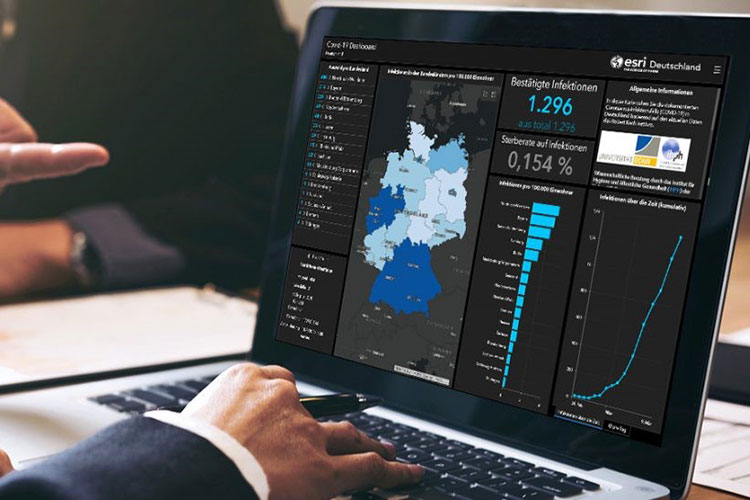
Data Visualization Against Corona
How can the spread of the corona virus be contained? What medical, economic, and social impact will the crisis have? Geoinformation systems, location intelligence, and predictive analytics can help with this analysis. A Bavarian software manufacturer is helping to combat the virus with interactive dashboards.
The Corona crisis affects every single person in all countries of the world. Within a few weeks, and with unimaginable speed, the virus took control of our lives and work. Headlines, forecasts, and even false reports have been coming out ever since. Under normal circumstances, real time factors and speed determine reporting. But now, knowledge and evidence are more important than ever, states Jochen Wegener, editor-in-chief of Zeit Online.
Data Creates Transparency
Data and experts against speculation and superficial knowledge. Esri, a software producer for Geographic Information Systems (GIS), has launched a cooperative effort with the Robert Koch Institute (RKI) and provides its analysis platform and expertise free of charge during the crisis. With their analysis tools and the interactive maps and dashboards, the data experts help to collect information and to visualize the effects of the crisis on health care, the economy, and our society.
The German subsidiary company is located in Kranzberg, near Munich. By now, everyone probably knows the diagrams from the news. Every day, the employees of the Corona Task Force create visuals for the Robert Koch Institute using the current case numbers from health authorities. The ArcGIS platform runs in the background by merging, analyzing, and visualizing data from various sources.
“As a journalist, you know you can rely on the RKI figures. The visualization through interactive maps and diagrams helps to communicate the information to readers and viewers in a transparent and understandable way,” explains Jürgen Schomakers, managing partner at Esri Germany.
Preventive Action with Interactive Maps
How many COVID-19 cases have been registered in the different Bavarian regions? Are there enough intensive care beds in the hospitals? And how fast do ambulances get to locations where there is an emergency? Context is crucial. GIS and maps help to gain an overview, plan assistance measures, and visualize hidden patterns. In order to support journalistic reporting, the maps provide information about interdependencies, connections, and temporal progressions.
“In the event of a crisis, it is essential to work in a quick and transparent way and to create a consistent overview for the various parties involved and their different tasks. Solid information is very important to analyze the situation and make the right decisions,” states Schomakers. The effects on commodity chains and supply flows, on public mobility, economic processes, as well as on the manufacturing industry or the insurance sector can be evaluated in detail.
Visualize the Invisible
The software provider has created a national platform for geographical data where, in addition to the case numbers of the RKI, further data sources are available for download.
In order to evaluate the data, engineers, developers, geo computer scientists, and cartographers work closely together with the Institute for Hygiene and Public Health, IHPH, the University of Bonn, and the Robert Koch Institute. In addition, volunteers work for the company’s internal “Disaster Response Program”, which has been helping out in disaster situations for over 25 years. For example, during the peat fire in Emsland, the cave rescue in Thailand, or during the hurricane season.
During the Corona pandemic, Esri supports more than 100 crisis teams in Germany and helps to set up the software as well as to evaluate the data. In addition to the German federal government, the local governments of Berlin and Brandenburg, the Federal Ministry of Health, and the Federal Office for Civil Protection and Disaster Relief can access the dashboards.
In preparation for future catastrophes, a joint transnational discussion on the topic of “Open Data Policy” would be useful. Schomakers states, “Data exchange and data consistency can significantly shorten the reaction times of emergency services in a crisis.”

Informations-Offensive der Apotheken-Umschau
Was die Menschen aktuell benötigen, sind verlässliche, einordnende und verständliche Informationen. Deshalb startet der Wort [&] Bild Verlag eine breit angelegte Informations-Offensive und hat für die Apotheken Umschau einen täglichen Corona-Newsletter sowie einen Podcast ins Leben gerufen. Wer hier zu Wort kommt? Ein Redaktionsteam aus Ärzt*innen, Pharmazeut*innen und Journalist*innen. Der Inhalt: tagesaktuelle Themen aus Medizin und Gesundheit rund um das Virus.
Livechat „Corona-Krise: Sie fragen, wir antworten“
So außergewöhnlich wie die Probleme der Betroffenen, so außergewöhnlich ist auch das neue Chat-Format „Corona-Krise: Sie fragen, wir antworten“ von der Süddeutschen Zeitung. Leser*innen fragen und das SZ-Leserdialogteam liefert fundiert recherchierte Antworten. Wer noch weitere Informationen möchte, der kann seine Fragen auch im Gespräch mit Fachautor*innen stellen. Die Gespräche finden mehrmals wöchentlich und zu gewissen vorgegebenen Themenschwerpunkten statt.

Neurofeedback-Therapie
Ganz billig ist das Angebot von brainboost allerdings nicht. Exakt 87 Euro kostet eine Stunde. Und es ist nicht verwunderlich, dass mehrere Sitzungen nötig sind. „Man muss ehrlicherweise sagen, dass ein sinnvoller Umfang zwischen zehn und 30 Stunden liegt. Wir versuchen, durch Prozessoptimierungen die Kosten zu senken. Aber wir wollen auf keinen Fall an der Qualität sparen“, sagt Philipp Heiler.
„Tatsächlich würde ich Neurofeedback als fortlaufenden Prozess bezeichnen. Ähnlich wie bei sportlichem Training kann ich mir Herausforderungen und Zwischenziele setzen, weil es mir guttut. Hier sieht man deutliche Parallelen zur Meditation“, fügt er hinzu. brainboosts ehrgeiziges Ziel ist ein Modell ähnlich dem eines Fitness-Studios. Nur geht es beim Gehirn-Gym eben um den Geist statt um den Körper.
Die gesetzlichen Kassen übernehmen die Kosten nicht, die privaten Kassen erkennen die Notwendigkeit im Einzelfall an. In weiser Voraussicht? „Ich sehe Neurofeedback als Zukunftstechnologie. Wenn immer mehr Jobs von Robotern übernommen werden, dann bleibt am Ende eine einzige Lebensaufgabe für die Menschen übrig: glücklich sein. Und das geht nur, wenn das Gehirn mitspielt. Genau diesem Zweck dient unser Neurofeedback.“