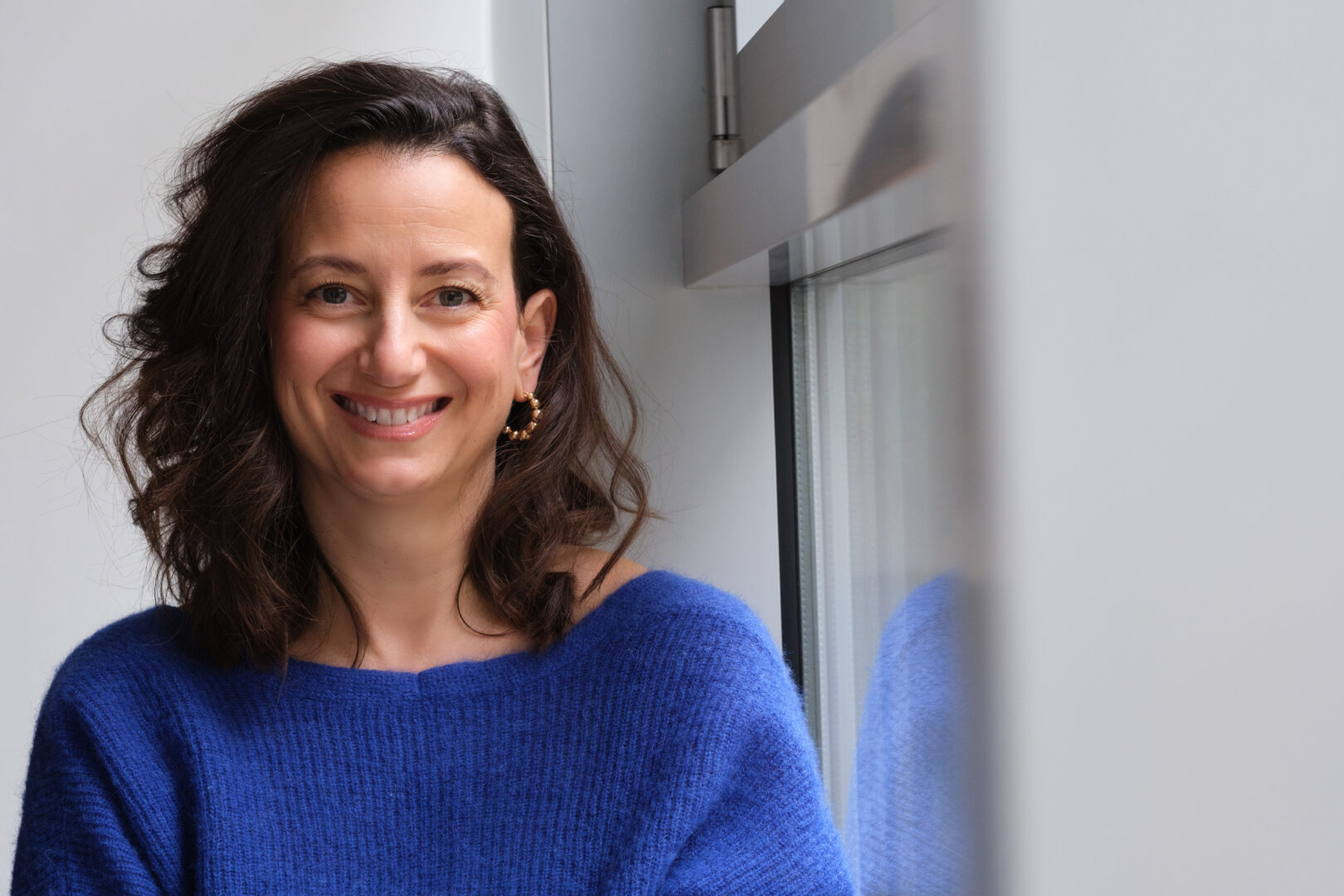
Mariam En Nazer: How Sustainability Works in the Book Industry
New legal requirements are also bringing the topic of sustainability increasingly into focus for publishers. The Penguin Random House publishing group, based in Munich, has created a new position to take a holistic view of the ecological transformation: Head of Sustainability. Mariam En Nazer has been working in this role since May. In this interview, she explains how the publishing group wants to become greener overall.
Mariam, how was your start in your new position as Head of Sustainability?
Mariam En-Nazer: It was a smooth transition for me. I had already been promoting the topic of sustainability at our publishing group for several years, but previously as Production and Sustainability Manager. However, the new position has made me realize once again how much creative freedom is involved and what expectations come with it.
Sustainability plays a major role in materials, printing processes and supply chains
Tell us more about your professional path to sustainability.
En-Nazer: I trained as a bookseller specializing in publishing production and worked directly in book production for many years. This involved materials, printing processes and supply chains – areas where sustainability plays a major role and where smart decisions can make a big difference. Over time, I increasingly asked myself how book production could be made more resource-efficient, for example through targeted material selection or optimized print run planning. It was this motivation that led me to complete a further training course in environmental economics. My professional positions then moved more and more in a strategic and sustainable direction.
What does a typical working day look like for you?
En-Nazer: A large part of my work consists of analysis: I evaluate data in order to derive concrete recommendations for action and measures. For example: Which materials have which ecological footprint? And at which locations and with which printers can a book be produced as sustainably as possible? At the same time, communication is an important component. I impart knowledge and sensitize people in the company to the topic of sustainability. I also deal intensively with legal requirements. The current focus is on the EU deforestation regulation, which will be binding for all publishers from the end of the year. We are also obliged to publish an environmental report in accordance with the CSRD.

The responsibility lies with publishers. We should always bring books onto the market in such a way that they can be bought with a clear conscience, without any extra demand.
Photo: Penguin Random House Verlagsgruppe
Mariam En NazerHead of Sustainability
You keep an eye on other departments when it comes to sustainability. Are there frequent discussions?
En-Nazer: I would rather say that I advise the departments and am their point of contact. One example is marketing, when it comes to the production of flyers, posters or cardboard displays. I help to find sustainable solutions, but without pointing a finger and without over-regulation. All employees should have the necessary know-how and the right tools to be able to act sustainably, even when making small decisions.
Which projects are particularly close to your heart?
En-Nazer: Generally speaking, we want to reduce our emissions by 50 percent by 2030. To achieve this, we need to tackle the issues with the greatest impact – from climate-friendly paper and optimized printing processes to sustainable forestry. One illustrative project that is close to my heart is the “Ich schenk dir eine Geschichte” (I'll give you a story) campaign run by Stiftung Lesen. Since 1997, around 1.1 million schoolchildren have been given a book from our publishing group as part of this initiative. This year it was the comic novel “Cool wie Bolle” by Thomas Winkler and Timo Grubing, published by cbj. I am proud of the fact that we have once again produced the book to the highest environmental standards: low-emission, FSC-certified paper, printed in Germany using renewable energy, without film lamination and completely cradle-to-cradle certified. This means that all components such as paper, inks, glues and varnishes can be fully returned to the ecological or technical cycle. This production method is explained in a child-friendly way on the last page of the book.
E-books are not automatically more sustainable than printed books
Would the industry be more sustainable if it relied more heavily on e-books?
En-Nazer: An e-book is not automatically more sustainable. It shifts the consumption of resources to servers and end devices, which are energy-intensive to produce and operate and will have to be replaced at some point. A printed book that is read frequently can therefore make more ecological sense than an e-book that sits unused on the reader. Studies show: You would have to read around ten e-books a year for the environmental footprint of a tablet to even out. And in the end, it is electronic waste – much harder to recycle than a paper book.
How important is sustainability to buyers?
En-Nazer: Sustainability is rarely a purchase criterion, but it does happen that customers ask about it – and that makes me happy every time. Nevertheless, it shouldn't be their job to decide between “sustainable” and “conventional” in the bookshop. You don't want just any book, you want exactly this one novel, and it's often only available in one edition. That's why I think the responsibility lies with publishers. We should always bring books onto the market in such a way that they can be bought with a clear conscience, without any extra demand.

What do you think about developments such as merchandising with plastic figures based around book characters or spray-painted book pages?
En-Nazer: That's an exciting point, because the target group demands elaborate refinements, especially in the “New Adult” genre. In my opinion, it's about consciously considering when such a production really makes sense. Many of these books are not simply thrown away, but kept and presented, which is also a form of sustainability through longevity. At the same time, each book project should consider how necessary such a step is. Graphic designers are also called upon to find creative ways to achieve strong visual effects with less finishing.
How do you rate Munich as a location? Are there good conditions here for a company to act sustainably?
En-Nazer: The Munich location is not so relevant for our production because we print throughout Germany and Europe. But as a publishing house, we benefit from the excellent infrastructure. Bavaria also promotes sustainable business, which generally creates a positive environment. For us, it's a good place to initiate and develop things further.
Finally, is there a book on sustainability that has particularly inspired you?
En-Nazer: I was very impressed by “Zukunft – eine Bedienungsanleitung” by Florence Gaub. The book is not directly about sustainability, but about how we can think and act in a sustainable way. The central idea is that the future doesn't just fall from the sky, it is shaped – and that's exactly how sustainability works. We have it in our own hands.
Bannerbild: Photo: Penguin Random House Verlagsgruppe

You may also be interested in
Mehr von XPLR: MEDIA in deinem E-Mail-Postfach
Der Newsletter von XPLR: MEDIA in Bavaria zeigt dir, wie innovativ der Medienstandort Bayern ist. Join the innovators!