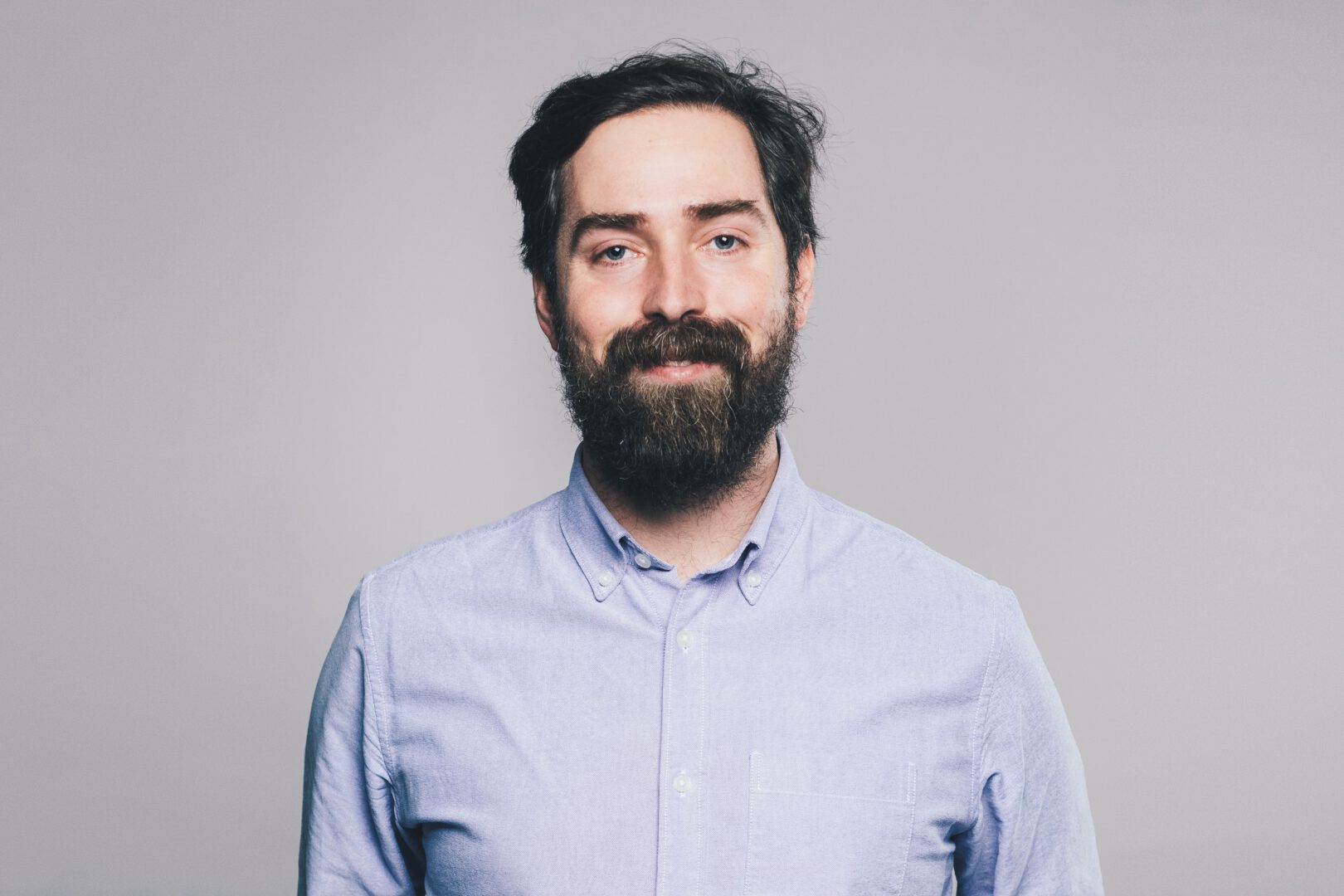
Matthias Leitner: Innovation Requires Freedom
Matthias Leitner is a digital storyteller who develops digital strategies and content for NGOs, foundations, and cultural institutions. Since 2015, he has headed the “audience:first storytelling lab” at Bayerischer Rundfunk (BR), where he also works with the BR's Format Development [&] Innovation team to implement pilot projects such as the messenger format “Ich, Eisner!” (I, Eisner!). In this interview, he talks about how innovation in media can succeed and what role AI plays in this.
Mr. Leitner, what originally drew you to the media world – and what keeps you there today?
Matthias Leitner: My journey began with a fascination for film; I wanted to be a director since fourth grade. Later, I quickly realized that I was less interested in the traditional film industry than in the intersections between theater, radio, film, digital media, and science. Rigid processes bore me. That's why I'm constantly looking for spaces where you can try things out, fail, and develop something new from that. What keeps me there is an enthusiasm for journalism. It shapes my work. I see journalism not only as a corrective, but also as a space of possibility, as a connecting element in society. Taking this role seriously and thinking it through is what drives me.
You work as a digital storyteller, UX designer, and certified Scrum Master (Scrum is a project management framework that works in short cycles) – how do these disciplines come together in your daily work?
Leitner: Among other things, I develop new formats and digital innovations at Bayerischer Rundfunk that are platform-appropriate, thematically relevant, and tailored to clearly defined target groups. As a digital storyteller, I think of dramaturgy in terms of content reaching our target group at the right time and in the right format. UX design is my methodological backbone: it forces me to take the user's perspective and structures the creative process. Agile principles, in turn, help me to work efficiently in interdisciplinary teams. Even without always taking on the classic role of a scrum master, I bring in tools and mindsets that give the process rhythm. That is my methodological framework, both at BR and in projects with cultural and educational institutions.
The more diverse the team, the better: friction breeds innovation
You often work at the intersection of journalism, technology, and society. How do you manage to bring these worlds together?
Leitner: I don't rely on interpretive authority, but on dialogue. I believe in teams that think differently. The more diverse the perspectives, the more exciting the process. I am still passionate about improvisational theater, and that is precisely what shapes my thinking: listening, reacting to impulses, and creating something previously unimagined together. This happens all the time at interfaces, where positive friction arises when technical, journalistic, and socio-political logics collide.
Your projects range from podcasts to AI prototypes to transmedia formats. What is important to you when selecting your projects?
Leitner: I look for projects that break new ground, thematically, formally, or technically. Not for the sake of innovation, but because I want to know what new narrative possibilities can be developed. It is important to me that these projects always generate knowledge about target groups, workflows, and technical limitations. The projects must therefore always provide information for the strategic orientation of the companies I work for.
Is there a project that is particularly close to your heart – and why?
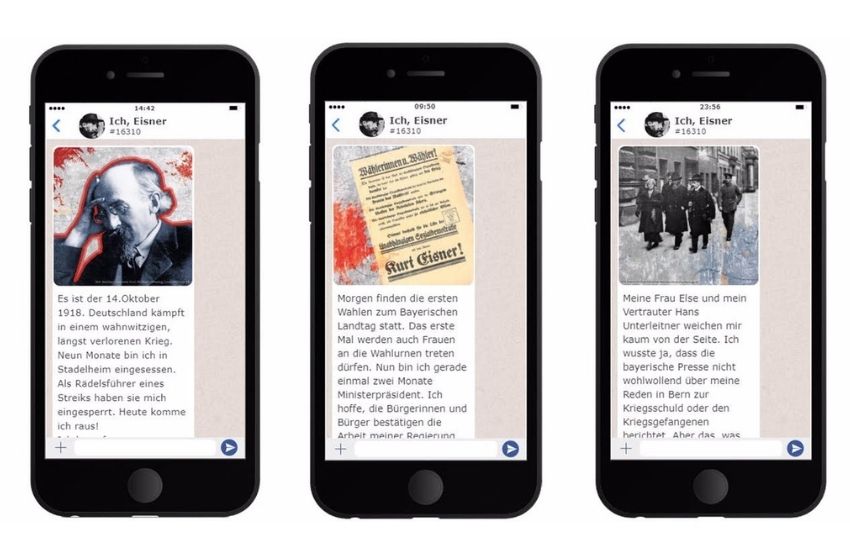
Leitner: #IchEisner was one such project. Together with Eva Deinert, Markus Malich, and many others, we recounted the revolution of 1918/19 for Bayerischer Rundfunk using messenger services such as WhatsApp. For four months, this took the form of a live dialogue with the audience from the perspective of Kurt Eisner. What excited me about it was not only the historical story, but the feeling that format and content can create a new form of closeness.
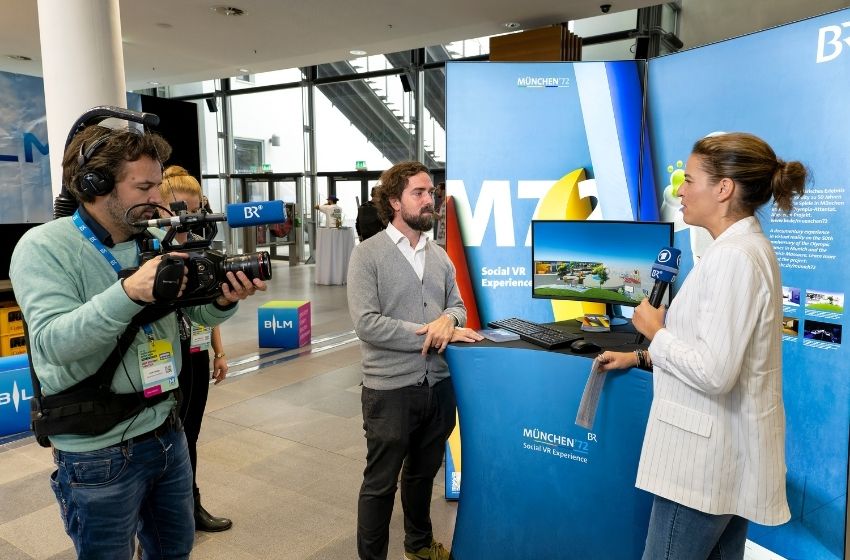
The project was very successful and opened up many new possibilities for us for what came next: for example, the VR documentary “München 72” or the AI-supported crime podcast “In 5 Tagen Mord – Die Krimi-Challenge mit KI” (Murder in 5 Days – The Crime Challenge with AI). It was also the first project in which we worked consistently in a prototypical, user-centered, interactive, and adaptive manner right up to the last second.
Many of your formats are participatory or interactive. Is that the future of storytelling?
Leitner: I don't believe in the future, but rather in different futures. Personally, I'm interested in formats where the target audience, topic, and technology influence each other. I myself am more lean-forward than lean-back: I want to engage with the material, the medium, and the audience. Sometimes this is achieved through interactivity. But a linear podcast, a great documentary, or a series can also generate resonance, of course. The decisive factor is always: Does it touch you? Does it connect? Does it change something?
The role of AI: The idea comes from humans, AI is a critical assistant
What role does artificial intelligence play in your projects – and how does it change the way you work?
Leitner: I mainly use AI for structuring, testing, and reflecting. It is my critical assistant. At the beginning of every project, I always start with a human idea, a vision that I formulate together with my team. And even at the end of the creative process, during the selection, curation, and approval stages, it is always humans who make the final decisions. AI cannot replace attitude, responsibility, or intuition. For me, it can do repetitive work and question my work before that happens again, but then by test users.
What developments in the media industry are you currently observing with particular interest?
Leitner: The biggest tectonic shift is, of course, AI. It is changing not only workflows, but also basic assumptions about how content is created and who controls it. At the same time, I am observing a retreat into the familiar: fewer radical innovation projects, more consolidation. This is understandable in times of multiple crises, but also risky. If we always link innovation to reach targets, we lose the ability to think long-term. Right now, we need projects that not only work, but also challenge us formally, in terms of content, and socially.
How can innovation really succeed in media companies?
Leitner: First: a common language. Many people talk about innovation, but what they mean is process optimization. By innovation, I mean new content, new narrative styles, new approaches. Second: trust in prototypical work, including mistakes. Innovation needs the right to fail in order to learn from it. And thirdly: spaces where not every idea has to be immediately scalable or monetizable. If you measure innovation solely by its return on investment, you stifle it before it can breathe. A good innovation system asks more questions than it provides answers at the beginning: What do we want to learn? What skills are we lacking? And how can we test this quickly and meaningfully? Does it have a future?
You have roots in Bavaria, and many of your projects originate here. What makes Bavaria a special media location for you?
Leitner: Bavaria offers enormous cultural, technological, and institutional density. That creates proximity. People meet, network, and develop shared visions. I work in an environment that is locally and internationally networked and operates across disciplines. I feel that this is also part of Bavaria's DNA in terms of its location strategy. And that's a real asset when you're working on projects that straddle storytelling, technology, and social relevance.
Rapid development: The biggest challenge in AI projects is staying up to date
Looking ahead to the next five to ten years, how do you think the media landscape will change?
Leitner: Recently, a colleague said to me during a jury meeting, “You never know whether this AI project will still be relevant in two weeks' time.” My colleague is a professor of artificial intelligence, and we were in the process of reviewing current AI projects in journalism. For me, too, the horizon in technical development is simply not foreseeable. But if I could wish for anything, I would wish for media that promote social resilience. Media that not only explain, but also connect, and in which human beings as feeling, thinking beings are always at the center.
What advice would you give to young media makers who are starting out today with the desire to help shape the media world?
Leitner: Try things out. Do playtests in your working life. You should have a plan, but not everything has to go according to plan. Many of my most important steps were spontaneous “yes” moments: joining the university radio station, auditioning for a presenter role, getting involved in a student film project that led to the founding of a company. These “yes” moments opened up opportunities for me and showed me, bit by bit, who I am, or rather who I am not.
So my advice is: test out different industries and work environments. Find out what suits you professionally, personally, and in terms of work rhythm. Don't define yourself too early based on who you are today. People can change through new experiences, and that's a good thing.
Bannerbild: Foto: BR/Lisa Hinder

You may also be interested in
Mehr von XPLR: MEDIA in deinem E-Mail-Postfach
Der Newsletter von XPLR: MEDIA in Bavaria zeigt dir, wie innovativ der Medienstandort Bayern ist. Join the innovators!