Remembering and Experience: Culture of Memory Through AR
Die Befreiung (“The Liberation”) by Bavarian broadcasting company Bayerischer Rundfunk gives visitors the chance to experience the liberation of Dachau Concentration Camp’s 75th anniversary via Augmented Reality (AR) and innovative storytelling. This digital project demonstrates how new technologies can profoundly change our culture of memory.
Once you pass the iron gate displaying the infamous phrase “Arbeit macht frei” (“work makes you free”), you enter an empty square. For visitors of the Dachau Concentration Camp Memorial Site, the place becomes a vivid scene where historical knowledge merges with their own imagination. However, some things are still unimaginable, such as the suffering of the prisoners, the cruelty of the perpetrators, and the bewilderment of the American soldiers upon entering the camp on April 29th, 1945. Thanks to broadcasting company Bayerischer Rundfunk (BR), visitors can now experience the past.
Virtual Tour – Bringing the Past to Life
75 years ago, Dachau Concentration Camp was liberated by US troops. To commemorate this anniversary, BR teamed up with Dachau Concentration Camp Memorial Site to create the multimedia storytelling project Die Befreiung.
“Thanks to technological progress, we now have new ways to remember,” Bayerischer Rundfunk producer Eva Deinert stated. “We are using technology to serve as a culture of memory.” Die Befreiung allows visitors of the memorial site to experience the decisive hours that unfolded on April 29th, 1945. With the help of an AR app, the memorial sites are enhanced with historical images and audio recordings. Memory and experience are thus brought closer together. Eyewitness accounts as well as photographs of prisoners, SS soldiers, and liberators illustrate the past and seem if for a brief moment to conquer the time gap between then and now.
Immersive Storytelling Through New Technologies
Experimenting with new ways to explain things and immersive storytelling is not something new to Deinert. As one of the editors of the award-winning BR innovation project Ich, Eisner (Me, Eisner), she has demonstrated how new distribution channels can be used to make history come alive. Political figure and revolutionary Kurt Eisner spent four months from fall 2018 to spring 2019 teaching interested parties about the accomplishments he had attained nearly 100 years ago through inspiring and engaging WhatsApp messages.
Interview with Eva Deinert about „Ich, Eisner“ and Storytelling (YouTube)
Die Befreiung focuses on a different technology with AR. The app was anticipated to already be in use, though the Corona lockdown has currently made visiting the memorial site not possible. Broadcasting company Bayerischer Rundfunk has therefore created a virtual visit of the Concentration Camp Memorial Site through an audiovisual experience on the website. With narrative voices, original recordings, and photos, the project bridges experience and reflection. The visit, though succinct, is still very vivid.
Using the Smartphone – Confrontation Instead of Distraction
“The focus lies on stories of young prisoners,” Deinert explained. “It was important for us to shed light on the stories of specific people.” This aim proved to be remarkably successful through the reunion story between Arthur Haulot and Paul Lévy. Online visitors are invited to discover the incredible story of Haulot, an imprisoned resistance fighter, and his Belgian compatriot Lévy, who worked as a journalist and interpreter for American soldiers. By chance, the two met again on April 29th, 1945. This astonishing record is a chance for visitors to simultaneously learn about the past and experience the emotions it brought about.
“If we want to reach younger target groups and raise their awareness of history, we must learn more about their media use and consumer behavior,” Deinert has explained. Smartphones do not have to be a distraction, but a tool to confront our history. “Teachers and students that tested a prototype of the AR app before the lockdown gave us very positive feedback,” the project manager stated. This is incredibly promising and therefore leaves a lot to be expected from innovative storytelling.
Wie kam es zu der Kooperation und was ist eure Rolle als Virtual Worlds?
Kahmke: Die internationale XR Crowd ist sehr wendig. Wir sind Innovatoren, weil es das, was wir tun, meist noch gar nicht so richtig gibt. Als Anfang März klar wurde, dass viele Festivals abgesagt werden müssen, traf sich die Community auf Social-Media-Kanälen, um Alternativen zu besprechen und zu testen. Mit VRroom und Stereopsia (den Partnern des BDTW20-Festivals, Anm. d. Red.) stand ich sowieso schon in Kontakt und als die mir von der Idee berichtet hatten, war ich sofort dabei. Ich aktiviere gerade meine Kontakte und frage, ob sie uns Experiences für die BDTW20 zur Verfügung stellen können. Das funktioniert sehr gut und alle wollen sofort mitmachen.
XR und VR-Experiences scheinen in der gegenwärtigen Situation für Events das Format der Stunde zu sein. Kann das der Technologie einen Schub geben?
Kahmke: Ich bin vorsichtig mit Prognosen. Die Technologie und Ideen gab es schon vorher. Noch im Januar haben wir zum Beispiel überlegt, ob wir Teile der Virtual Worlds zusätzlich in VR streamen sollen. Damit Menschen teilhaben können, die nicht nach München kommen. Ich finde es spannend, dass in dieser Zeit sehr viele Medien plötzlich genutzt werden, die vorher schon ein Angebot hatten, aber damit nicht unbedingt die breite Masse erreichten. Für mich bleibt ein Festival ein Ort der Begegnung, der offline eine andere Qualität besitzt. Die persönliche Neugierde, die Spontanität und das persönliche Gespräch bleiben weiterhin unverzichtbar. Deswegen verschieben wir auch die Virtual Worlds, weil wir keinen eins zu eins Ersatz in der virtuellen Welt suchen. Was die Technologie aber kann, ist das Konservatorische. Es gibt ganze Museen und Ausstellungen, die man sich mit VR anschauen kann.
Frank: Man merkt generell die Zunahme derer, die sich professionell mit VR beschäftigen, an der immer besseren Qualität. Wir zeigen zum Beispiel im Rahmen des BDTW20 Festivals den Film „Traveling while black“ von Felix[&]Paul, der letztes Jahr auch in der Retrospektive bei Virtual Worlds lief. Es gibt da eine wahnsinnige erzählerische Qualität im Spiel mit dem neuen Medium. Das haut einen wirklich um, wenn man es das erste Mal sieht.
Weiterführende Links:
Mehr zum Programm des und der bayerischen Teilhabe am Break Down These Walls Festival verrät Astrid Kahmke im Interview mit dem XR Hub Bavaria.
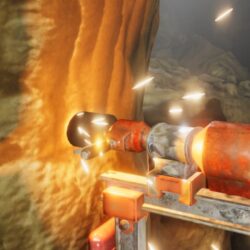
Screenshots aus dem VR-Adventure „Blautopf VR“ (Foto: Philipp Schall, TELLUX Next GmbH)
Neurofeedback-Therapie
Ganz billig ist das Angebot von brainboost allerdings nicht. Exakt 87 Euro kostet eine Stunde. Und es ist nicht verwunderlich, dass mehrere Sitzungen nötig sind. „Man muss ehrlicherweise sagen, dass ein sinnvoller Umfang zwischen zehn und 30 Stunden liegt. Wir versuchen, durch Prozessoptimierungen die Kosten zu senken. Aber wir wollen auf keinen Fall an der Qualität sparen“, sagt Philipp Heiler.
„Tatsächlich würde ich Neurofeedback als fortlaufenden Prozess bezeichnen. Ähnlich wie bei sportlichem Training kann ich mir Herausforderungen und Zwischenziele setzen, weil es mir guttut. Hier sieht man deutliche Parallelen zur Meditation“, fügt er hinzu. brainboosts ehrgeiziges Ziel ist ein Modell ähnlich dem eines Fitness-Studios. Nur geht es beim Gehirn-Gym eben um den Geist statt um den Körper.
Die gesetzlichen Kassen übernehmen die Kosten nicht, die privaten Kassen erkennen die Notwendigkeit im Einzelfall an. In weiser Voraussicht? „Ich sehe Neurofeedback als Zukunftstechnologie. Wenn immer mehr Jobs von Robotern übernommen werden, dann bleibt am Ende eine einzige Lebensaufgabe für die Menschen übrig: glücklich sein. Und das geht nur, wenn das Gehirn mitspielt. Genau diesem Zweck dient unser Neurofeedback.“
Weitere Informationen
wikipedia.org : Instrumentelle und operante Konditionierung