TikTok Expert Marion Uschold: Journalism on Equal Footing
TikTok is the platform for reaching young audiences—yet not all media companies are willing to venture there. Why not? How can barriers be broken down, and what constitutes good TikTok content? Marion Uschold is a digital expert at BR (BR24, Bayern 3) and reveals what matters in an interview.
LinkedIn, Instagram, TikTok, YouTube – which platform is currently the most promising for a media company looking to expand its brand?
Marion Uschold: As a media company, I first have to ask myself: Where is my target audience and what are my goals as a brand? Then, in a second step, I can consider which platform is best suited to me. LinkedIn is used by specialist audiences and older target groups, Instagram and TikTok, on the other hand, are aimed at younger generations and are still growing rapidly. YouTube is a platform where I can reach all age groups. Long-form content scores particularly well here. In general, it's fair to say that the optimal solution is never just one platform, but always the right combination.
TikTok is very popular with younger generations. Why is the platform indispensable for media companies today?
Marion: Because social media has become a source of information today – as shown by recent reports such as the Reuters Digital News Report. According to this report, 35 percent of 18- to 24-year-olds consume news and other information mainly on social networks. As a media company, it is also important to be represented on TikTok because it is a place where you can learn about trends and topics that are currently moving people.
The TikTok algorithm learns solely from user interaction
How does the platform or its algorithm work?
Marion: The TikTok algorithm focuses on content and learns solely through user interaction. How many likes and comments does my content get, how long and how often is it viewed, how many people follow me after seeing my content? All of this plays a major role. Basically, the algorithm is structured like a staircase: first, my content is shown to a small audience. If they interact sufficiently, the circle of viewers is expanded.
What requirements must content meet in order for users to interact as much as possible?
Marion: First, it has to be relevant and fit my target audience. Second, it needs a strong hook. If I don't catch my audience's attention in the first second, they'll immediately scroll to the next video. Good storytelling is also important to keep users engaged with the video. After all, it's good for the algorithm if users engage with my content for as long as possible.

Almost every editorial office has interns and trainees – many of whom are very familiar with TikTok and eager to try their hand at it. It only makes sense to involve them and work together to come up with ideas for content.
Photo: Leah Ruprecht
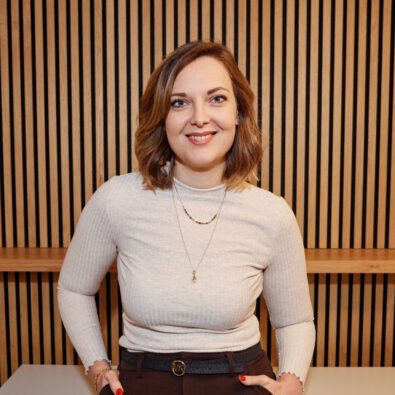
Marion UscholdDigital expert at BR
What trends are you currently observing on TikTok that people should be aware of? In what direction is the platform developing in general?
Marion: The trend I'm seeing very strongly right now is the 16:9 trend. This means that TikTok is currently pushing the new format enormously in an attempt to become a strong competitor to YouTube. We tried this with Bayern 3 and were able to achieve six-figure reach. Another development that has been emerging for some time is that TikTok is being used as a search platform. The platform is responding to this by further expanding its search function. And, of course, AI is a big topic: a few weeks ago, TikTok rolled out the “Symphony” feature, which allows users to use digital avatars and translate their content into different languages, for example.
Leveraging TikTok affinity: Interns and trainees provide valuable input
Some media companies still don't dare to use the platform. What concerns do you encounter time and again?
Marion: Many say they don't understand the platform and its algorithm because they don't have an account themselves. The only way to overcome this hurdle is to dare to try new things and let loose. A common argument is a lack of staff to manage the TikTok account. I always urge people to consider what resources they could reallocate. Sure, content doesn't create itself, but often you can strike a chord and achieve good reach with relatively little effort. It doesn't always have to be a time-consuming and costly high-gloss video.
How can you make getting started a little easier?
Marion: Almost every editorial office has interns and trainees—many of whom are very familiar with TikTok and eager to try their hand at it. It only makes sense to involve them and brainstorm ideas for content together. I would then consider certain strategic goals and simply start posting content online. TikTok gives me a lot of information about how my content is being received. This allows me to evaluate which videos work better than others, what I could change, and what I could try out. I think it's important that, as a medium, you don't necessarily “act young” and try to ingratiate yourself, but remain authentic. Then you'll find the community you want to appeal to.
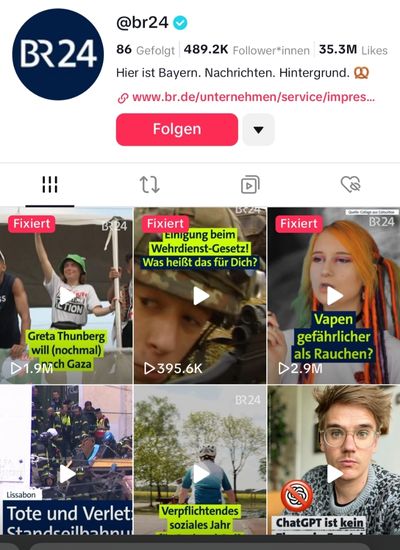
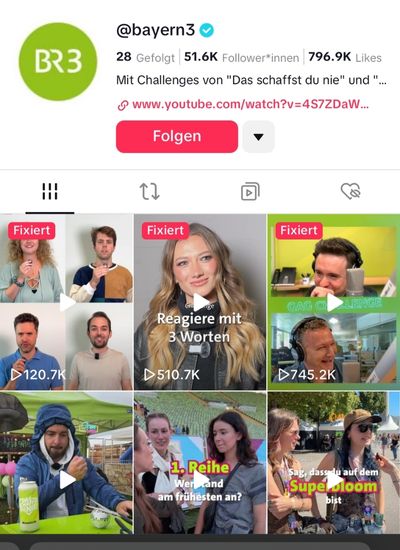
This is exactly what you can use to exchange ideas on social media. How does good community management work?
Marion: The most important thing is to consider community work important and to communicate with people on an equal footing. As media makers, we no longer communicate from above, but become companions and mentors. This makes journalism much more accessible. The fact that the community approaches us with their ideas and needs gives us the opportunity to engage in dialogue, clarify ambiguities, and find out what topics people are interested in. The nice thing is that our community is our multiplier. If they like our content, like it, share it, and save it, it has a positive effect on the algorithm.
Not only are you a digital expert at BR, but you also visit schools to teach media literacy. What do you observe there – how do children and young people interact with media today?
Marion: Since many users rely on social media as a source of news, it is all the more important to develop a certain level of media literacy. In my experience, this is often lacking. I do believe that Gen Z and Alpha have a basic understanding of how social media works. But recognizing AI-generated content and fake news is difficult even for media professionals—sometimes entire teams work on fact-checking. I still see a great need to educate young people and teach them how to critically question content.
News on TikTok must be snackable and well presented
Journalistic content shares the stage on social media with lifestyle, comedy, shopping, advertising, etc. Is this primarily a challenge, or does it also present an opportunity for media companies?
Marion: I see it as an opportunity because it allows media companies to reach people who are tired of dry news. With well-prepared, concise, snackable news, they can end up in the feeds of young people on TikTok and other platforms, giving them the opportunity to get people excited about news again. It's a challenge, but there's no alternative – because you simply can't reach young target groups via linear media anymore.
Bannerbild: Photo: BR/Ralf Wilschewski
You may also be interested in
Mehr von XPLR: MEDIA in deinem E-Mail-Postfach
Der Newsletter von XPLR: MEDIA in Bavaria zeigt dir, wie innovativ der Medienstandort Bayern ist. Join the innovators!