Kevin Ebert from PULS Reportage: On Extremes, Self-Experiments, and Limits
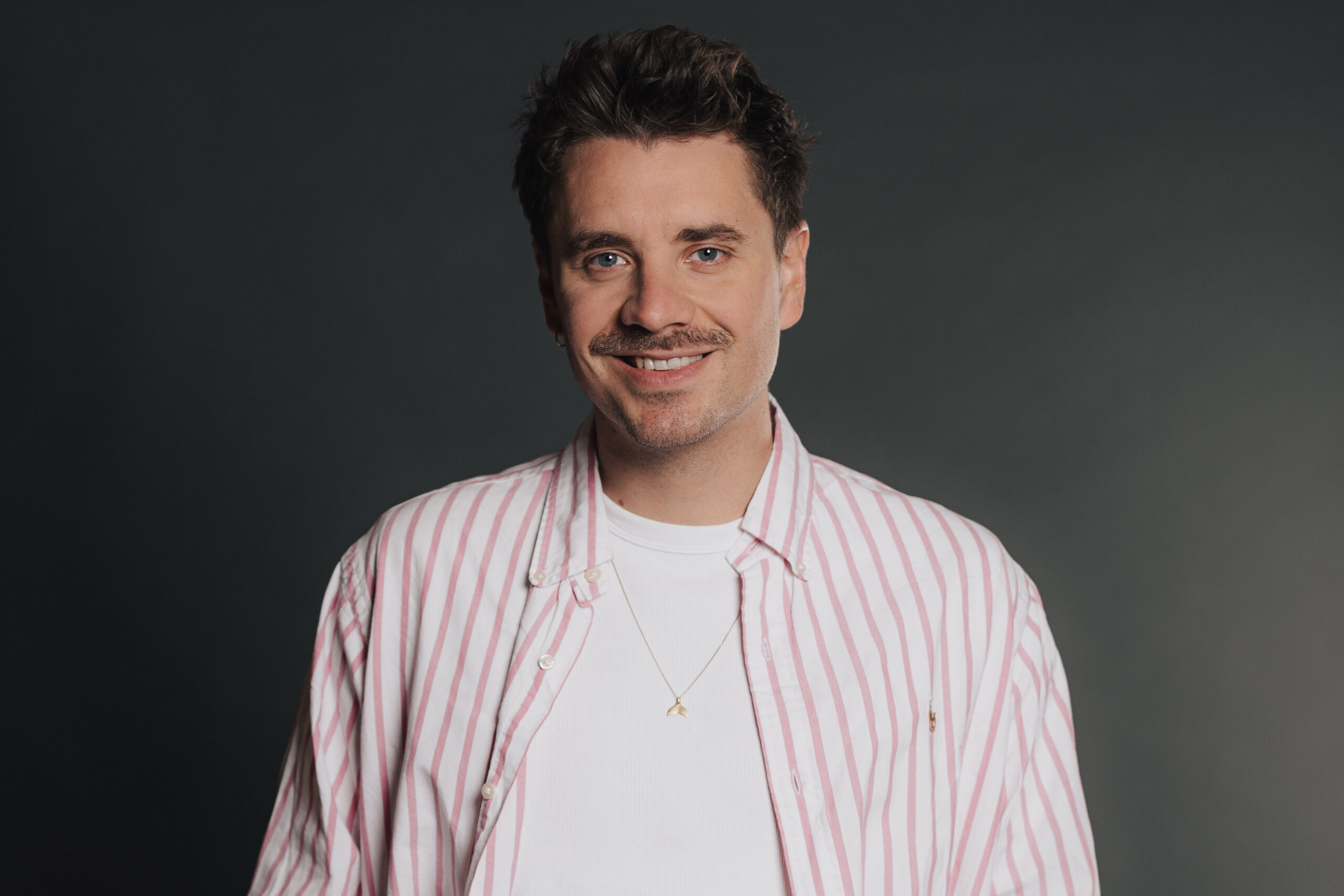
The PULS Reportage is one of BR’s most successful programs: It’s not uncommon for each episode to attract over a million YouTube views. As one of the hosts, Kevin Ebert has already found himself in exciting, shocking, and exhausting situations. In this interview, he talks about how the job of a reporter affects him and how his personality shapes the show.
Kevin, you’re the face of a format that thrives on personal experiments. How much of “private Kevin” goes into your reports, and where do you draw the line between that and being a professional reporter?
Kevin Ebert: On every shoot, it’s really important to me that I feel comfortable and can just be myself—that I don’t have to put on a show. It’s also really important for the show that viewers get to know me—that they get a sense of how I talk, how I carry myself, what my apartment looks like, and what a quirky guy I am. (laughs) For example, I also talk very openly about my ADHD, which I just made a film about. Still, there are limits. When a topic veers toward sex education and sexuality, I’m very careful about how much I want to reveal about myself. After all, these reports can sometimes be seen by up to a million people.
You often put yourself in extreme situations—from military deployments to slaughterhouses. Which moment has pushed you closest to your personal limits so far?
Kevin: The most physically extreme experience was the report I did on the German Armed Forces. It was a personal experiment in which I spent a night participating in a military exercise as a recruit. There were gunshots everywhere, I was grabbed, and I had to take part in a forced march—it was really stressful and exhausting. But I’d still say that the most intense, boundary-pushing experience for me was witnessing an autopsy. I’d never dealt with the subject before, and then to see a human body being cut open—my legs were shaking pretty badly. That was definitely not on my bucket list, and it lingered in my mind for days afterward.
Extreme situations are part of everyday life for the PULS editorial team
What personality traits help you handle such experiences well?
Kevin: Actually, I like my job mostly because of these extreme situations. Of course, not every film is extreme, but I really enjoy working on these kinds of topics. Because I find it fascinating to see how other people live or work. I’m a curious person—and almost annoyingly impatient. (laughs) It helps if you’re genuinely interested in things and ask questions at the right moment. And something else I’m good at: making people feel that they can trust me and open up to me without me judging them. At the same time, I’m pretty good at maintaining a certain distance. After all, I’m not our protagonists’ new best friend—I’m still a public broadcaster journalist who sometimes has to ask uncomfortable questions.
A PULS report often lasts 20 minutes—which feels like an eternity in the age of TikTok and YouTube Shorts. Why does long-form content still work so well for you on YouTube?
Kevin: Of course , we know that younger people’s viewing habits differ from those of older generations. We’re learning a lot from platforms like TikTok, Instagram, and YouTube Shorts when it comes to editing and speaking speed. But it’s a big misconception to assume that young people only ever want quick dopamine hits. They want information just as much; they want to dive deep into topics. However, certain elements have to be right for the content to work: the music has to be right, the graphics have to be fast-paced and engaging, the host’s tone has to be approachable, the host’s personality has to connect with the audience, and the editing can’t be too slow.
Before the PULS report, you hosted other formats, such as the podcast “Im Namen der Hose.” How has your storytelling changed since you started producing primarily for YouTube?
Kevin: “Im Namen der Hose” is a typical host-driven format where journalistic research does play a role, but the focus is primarily on the host’s personality. It’s very intimate—partly because the podcast is right in your ear, and partly, of course, because of the topics surrounding sex education and sexuality. I learned a lot there, especially when it comes to setting boundaries.
I’ve been with PULS Reportage for a very long time—first as a researcher behind the camera and now as a traditional reporter. Here, I combine my journalistic and storytelling expertise; I know that I’m telling a subjective story, which facts and information I need to include to round it out, and how I can build suspense and create dramatic tension. Of course, this also comes with a sense of responsibility.
A Familiar Face: A BR Representative Also Serves as a PULS Host
How do you handle this responsibility? As the face of PULS Reportage, many young people know you, and you also have over 12,000 followers on your personal Instagram account.
Kevin: That makes me really happy and I’m truly honored. As a PULS reporter, I’m also a kind of representative for BR, and I usually keep that in mind when it comes to what I post or how I conduct myself in public. Don’t get me wrong: No one tells me what to do in any way. Still, I think carefully about what political content I publish or how I behave on the road—for example, if another driver annoys me. But that’s not hard for me at all, because I’m a cuddly bear who craves harmony anyway. (laughs)
Let’s talk about your topics. How much market research goes into deciding on your topics, and how much is just a gut feeling about what’s currently on the community’s mind?
Kevin: We have a very elaborate process for identifying topics. We know which topics go over well. There’s certainly a lot of experience and gut instinct involved, but PULS’s analytics department also does a great job here. They know exactly which metrics to look at, how we track our content, and what criteria we need to focus on for future productions. Of course, we get it wrong sometimes, but our failure rate is really low.
What the community really loves: behind-the-scenes glimpses and hands-on experiments
What are those criteria?
Kevin: We always want to offer a peek behind the scenes. To do that, we take a look behind the scenes of certain areas that people are familiar with, but that are too far removed from their own everyday reality. For example, an emergency room or the lifestyle of a truck driver. What also goes over well are personal experiments that many people wouldn’t be able to do or would find too extreme. Sometimes we also deliberately cover topics that we know won’t perform quite as well but are still important—for example, politics and elections.
Do you also get topic suggestions from your community?
Kevin: Yes, our viewers are constantly suggesting topics, which we then cover. This is very valuable to us because it lets us know what matters to our community. Community management is a very important priority for us anyway. There’s at least one person responsible for it every day, even on weekends. It’s important to us to be present—to address issues when they come up, but above all to build a connection. I also check the comments on my personal YouTube account. I always read them, and I want to show that, too. That can sometimes be difficult for me, though, because I do take criticism to heart.
Bannerbild: PULS Feature Story