5 Quotes That Stuck With Us From the 1E9 Festival of the Future
Under the motto “Join the Future!,” the Festival of the Future 2026, presented by 1E9 Think Tank and the Deutsches Museum, brought together leading minds from the worlds of technology, science, business, and the arts in downtown Munich.
More than 150 experts discussed the trends of tomorrow in over 100 sessions: from quantum computing and robotics to cutting-edge medicine. But what do groundbreaking developments in artificial intelligence, new XR experiences, and changing consumer habits actually mean for creatives and media professionals? We’ve summarized the key takeaways from the Festival of the Future for you:
The negative consequences of AI arise on their own—but we have to work actively to achieve the positive ones.
In his keynote address, “We Don’t Need More of This AI,” Prof. Dr. Björn Ommer (LMU Munich) spoke candidly about current developments in AI. While it may feel as though there are 82 million AI experts in Germany, he argued that the debate is falling short. According to Ommer, we are already experiencing a phase in which AI-generated content is surpassing human-produced content online in terms of volume. The consequences of this current wave of AI directly affect the media industry: an enormous concentration of power in the hands of a few tech conglomerates, dependencies, the loss of entry-level jobs for young talent, and a massive erosion of trust due to low-quality content.
The core problem: The negative effects of AI arise entirely automatically. For the technology’s positive promises—such as the transition to a true knowledge society—to be realized, we would have to actively work toward them. For Europe as a media hub, this means that simply playing catch-up and merely optimizing existing processes is not enough. We would need to carve out our own niches, for example by developing highly efficient, specialized algorithms.
The lesson for media professionals: The positive potential of AI doesn’t just happen on its own—we must actively demand and shape it.
To survive, media companies must focus on their communities.
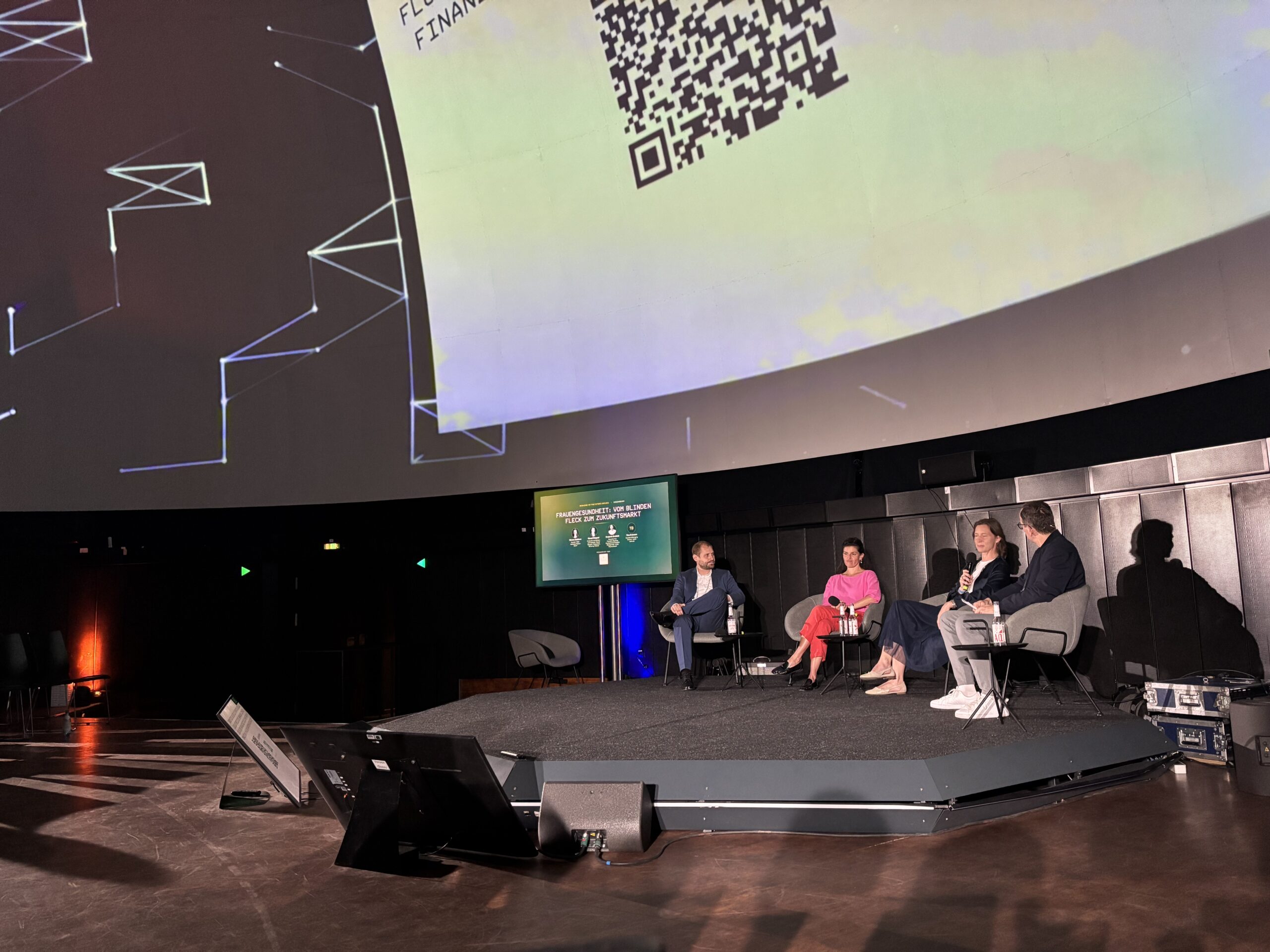
Klaus Meier (KU Eichstätt-Ingolstadt), Uli Köppen (BR), Monika Pilath (DIE ZEIT), and Alexander von Streit (Krautreporter) in the session “Answers Without a Sender: What Remains of Journalism When AI Responds?” AI models pose a threat of massive declines, especially for reach-based media, as they increasingly result in fewer clicks on websites. According to von Streit, large, purely ad-supported business models are a thing of the past; the future belongs much more to smaller, community-based models. Journalism needs a new mindset and must find venues for exchange—such as events—to nurture its relationship with the audience.
At the same time, the value of media companies is shifting toward two core areas: trust and data. While major newspaper publishers have already successfully deployed AI internally as a tool to boost efficiency—for example, when conducting research involving vast amounts of data—human beings remain essential as trustworthy sources in direct dialogue. Strategically, according to BR AI Director Uli Köppen, the industry must also significantly accelerate its own product development. One model for the future could be the fair, regulated sale of media data on emerging data marketplaces.
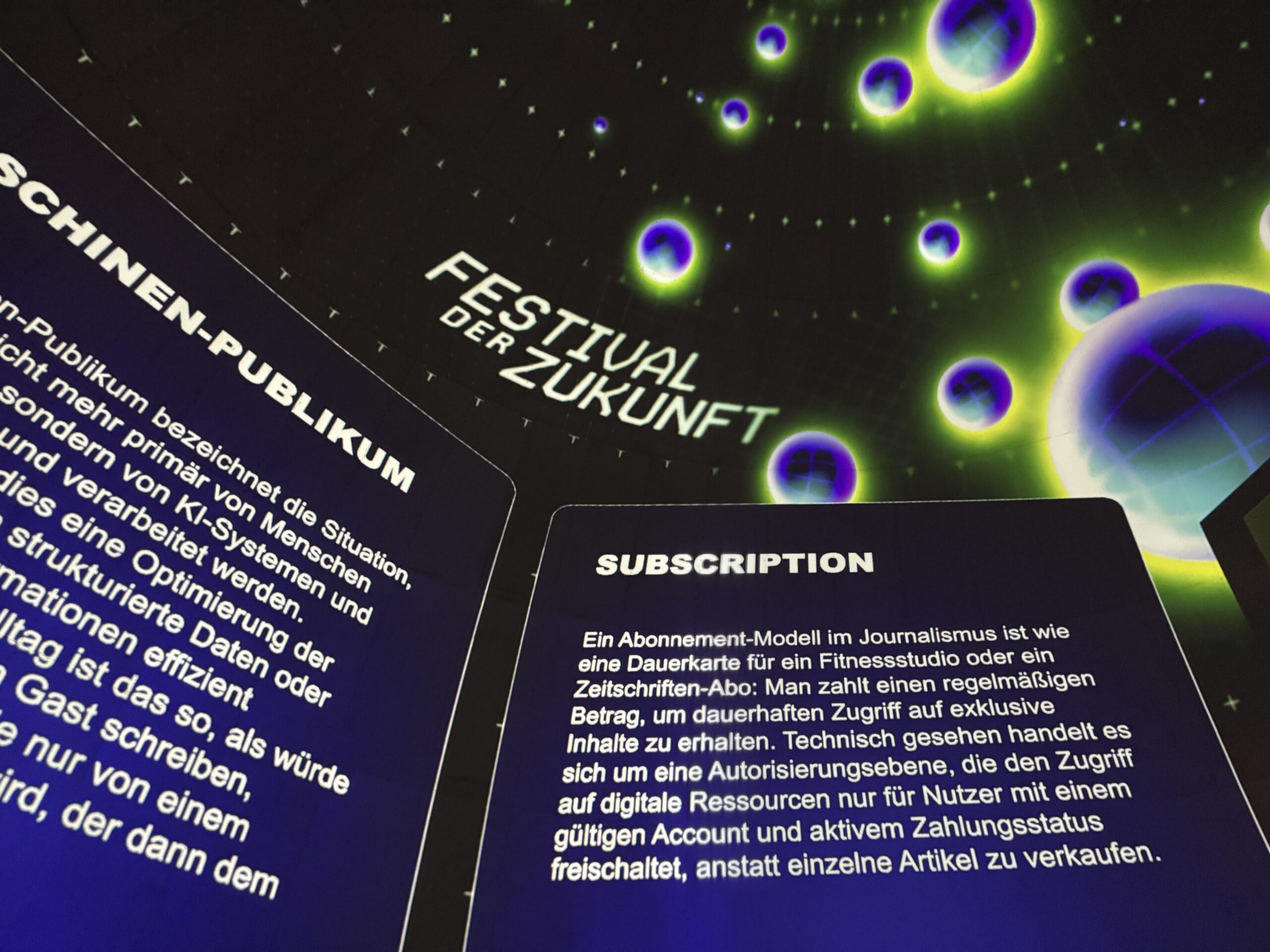
Journalism could learn a thing or two from the gaming industry.
The growing “zero-click” reality is hitting publishers hard. For the “Apotheken Umschau” website, for example, this led to a massive 60 percent drop in revenue, as Harald Mandl (Wort & Bild Verlag) reported during the session “Zero Click, Zero Cash?” moderated by Bernd Oswald (Bayerischer Rundfunk). Even publishers in a comfortable monopoly position, such as the Augsburger Allgemeine, represented by Lena Jakat, are feeling the pressure on their resources. But how can digital content still be monetized in the future? Dirk von Gehlen (SZ) emphasized that content alone has long since ceased to be the main reason for a subscription—it’s about appreciation and a sense of belonging to a community.
At this point, the industry might be able to learn a thing or two from the gaming industry: The gaming industry generates revenue through extremely successful free-to-play and microtransaction models. Paul Redetzky (Emergo Entertainment) suggested applying this principle to journalistic media. The key to success in gaming, he said, is interactivity: Players pay for the feeling of having a say and being a visible part of a fictional world. Digital gaming successes like Wordle (SZ) already show that gamification works in journalism as well. If publishers stop viewing their audience solely as passive readers and instead create more interactive experiences and simulations, entirely new revenue models could emerge.
We in Europe have a major problem—and we need to become independent.
Europe’s technological sovereignty is at stake, and the media industry is directly affected. In his keynote address, Dr. Fabian Mehring, Bavarian Minister of State for Digital Affairs, put it plainly: Europe must recognize that digital technologies such as AI, XR, and quantum computing are the future. To become and remain independent—and to avoid ending up at the “back of the table” in the digital world—Europe needs its own tech champions and the willingness to boldly shape cutting-edge technology.
Munich and the state of Bavaria are positioning themselves as a digital powerhouse: Thanks to the Bavarian High-Tech Agenda, over five billion euros have already been invested, making Bavaria one of the top 20 tech hubs worldwide. This offers enormous opportunities for the media and creative industries—especially in future-oriented fields such as Extended Reality (XR). Mehring’s call to action: The government must reduce bureaucracy and act as an anchor customer for innovative tech solutions.
For AI to be truly valuable to us, we need a goal we want to achieve.
“When will we finally get there?” With this question, tech journalist and AI expert Gregor Schmalzried looked back on the rapid developments in AI over the past two and a half years during his keynote address. What he specifically meant was: When will we finally reach the level of quality we’d like to see in our use of AI?
Skepticism is growing in Germany. According to surveys, 45 percent of people fear that AI will make their lives worse. While AI has improved significantly in some areas, such as image and video generation, the quality of text-based work has stagnated. Is the AI revolution ultimately nothing more than an empty promise?
To understand this, we need to look at which capabilities AI possesses and which ones (still) lie with humans. AI excels at reproduction and transfer—that is, at interpreting existing data. What it completely lacks, however, according to Schmalzried, is the ability to reflect. Questioning and the conscious creation of something new remain core human competencies. For media companies, this means that AI will only become a true aid if we ourselves remain capable of taking action. We must not allow ourselves to be paralyzed by the sheer volume of AI-generated content. To steer the technology in a meaningful direction, we need a clear, overarching goal that we as a society and as the media industry want to achieve. AI helps us achieve it.
Bannerbild: XPLR: MEDIA in Bavaria