Stories are Brought to Life with WeDaVinci´s “Visionary Tales”
Moving images have long been a luxury medium: complex and expensive. Generative AI lowers these barriers and makes professional videos possible even when no images exist—such as in the case of novel-based stories or film projects that haven’t yet been produced. The Bavarian startup WeDaVinci developed the Visionary Tales platform specifically for this purpose.
A few years ago, the idea would have sounded like science fiction: You upload a few pages of a concept—and shortly thereafter, it’s transformed into a visually polished trailer featuring impressive scenes, realistic characters, dialogue, and a voice-over. That’s exactly what the Bavarian startup WeDaVinci has developed a tool for—making it one of the pioneers in the use of generative AI.
“WeDaVinci offers a platform for AI-based content generation, particularly short-form video formats such as trailers,” says co-founder Veronika Gamper in an interview with XPLR: MEDIA in Bavaria. The solution is currently aimed specifically at an industry that, while it has compelling stories, has produced very little moving imagery to date: the book industry.
The core idea behind WeDaVinci’s web-based tool “Visionary Tales”: Publishers can use it to produce trailers for their titles, making it easier to convince production companies to adapt them into films. The AI doesn’t function as a “black box” where you simply enter a prompt—and then hope for a good result.
Not a Video at The Push of a Button, but Co-Creation
“First, you enter a text. This can be an entire manuscript, in which case the AI selects the most relevant scenes for the trailer. Or it can be one to five pages of scenes you’ve chosen yourself, ideally with a description of the story, the characters, and the locations. WeDaVinci then immediately provides users with suggestions for three synopses of the trailer,” explains Veronika Gamper. Users can then choose which version they’d like to pursue: Should the trailer focus more on a single character? On a relationship between two characters? Or on a specific mood?”
Compared to last year, I’m seeing a much greater openness toward AI—and a very concrete interest in how such tools can be integrated into existing processes.
Founder Veronika Gamper
The platform then suggests scenes, character designs, and locations. Based on this, even complex or difficult-to-create worlds can be brought to life visually—such as historical settings or fantasy scenarios. At every step, users can provide direction using natural language—such as a character’s appearance, the style of the images, or the dramatic structure of the scenes. Only then are these transformed into animated video sequences.
The end result is a video clip lasting one to three minutes—including suggestions for music, dialogue, and voice-overs. The individual sequences can then be exported and further edited and finalized in standard video editing software. The WeDaVinci team considers one principle to be particularly important: The platform should enable genuine collaboration between humans and AI.
“We don’t just make a video at the push of a button. People contribute their knowledge about the intent, target audience, and content,” says Veronika Gamper. “First, I get suggestions from the AI, and then I’m guided through the process using natural language.” That’s why the company calls its approach “Human-AI Co-Creation.”
Video Marketing is Becoming More Affordable and Widely Accessible
WeDaVinci deliberately chose book trailers as their first major use case—primarily because they were virtually nonexistent until now. “This was rarely done in the past—maybe for major bestsellers,” says Veronika Gamper. For most titles, this form of marketing—although well-suited for the all-important social media campaigns—has remained prohibitively expensive until now. With AI, significantly more books can now be presented visually.
“I can communicate and visualize what I have in mind within 30 seconds to two minutes,” explains Veronika Gamper. This is also useful for marketing film rights—especially for bringing projects to life early on, even before filming begins. A short trailer can show producers more quickly the mood and potential of a story.
For film producers and screenwriters, too, the tool could open up new opportunities to present their ideas—for example, in the form of a “sizzle reel,” which is frequently used in the film industry to pitch projects to funding organizations or investors.




Award at the Berlinale
A platform like WeDaVinci has only become possible thanks to the rapid development of generative AI. “The most important advances for us were the ability to generate and edit images and videos using natural language—and the ever-improving AI models,” says Veronika Gamper. Above all, she notes, it is crucial that AI can now consistently depict characters and locations across multiple scenes.
WeDaVinci guides users from the text through the storyboard to the final video. In doing so, the company not only combines various technical workflows and models but also fine-tunes models for specific use cases and styles. “We bring together our expertise in film, writing, and AI, thereby relieving users of the need to make technical decisions behind the scenes,” explains Veronika.
The team reports that the response from the media and film industries has been very positive. Discussions with publishers, authors, and producers in particular have shown that there is significant interest in such tools, and that this interest continues to grow. “Compared to last year, I’m seeing a much greater openness toward AI—and a very concrete interest in how such tools can be integrated into existing processes,” says Veronika Gamper.
The fact that the idea struck a chord in the industry was also evident at the Berlinale: At the European Film Market, the film industry’s international trade event, WeDaVinci was honored with the EFM Startups Award 2026.
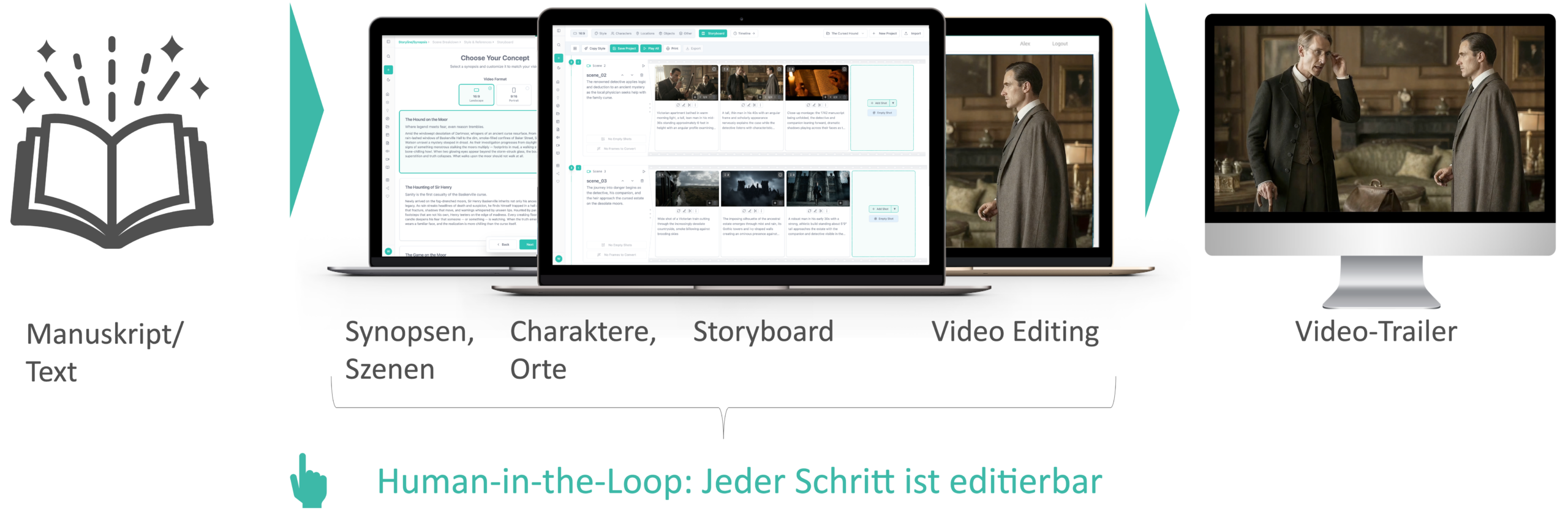
The WeDaVinci Workflow Explained. / Graphic: WeDaVinci